Thursday, September 25, 2014

You're still going to die

A few days ago there was a post up on The Pump Handle reporting on the Institute of Medicine's report, Dying in America, that critiques end of life care and suggests ways to improve it. The post linked to to an essay by Ezekiel Emanuel in The Atlantic on the topic of old age and death. The essay has the rather catchy title of "Why I Hope to Die at 75."

As it turns out, Emanuel doesn't really hope to die at 75. He's just decided that once he hits a certain point in his life, he's going to refuse all medical interventions other than palliative care. I get it. I've worked in nursing homes. I know that despite all the hype about "60 is the new 40" and ads showing geezers having a good time, aging in general sucks. You get older and it's inevitable that you're going to start falling apart. No one has the energy at 80 that they did at 50. You're more susceptible to injury. Your skin turns crepe-y, you bruise easier, it takes longer to heal. A fall that would have been nothing when you were in your 20s can put you in the hospital when you're in your 70s. Old people look frail for a reason -- they are frail. They break easy. Your bones start losing calcium; if you're unlucky you end up with osteoporosis and discover that all it takes is a sneeze and you've got broken ribs. Everyone says getting old beats the alternative, but some days you've got to wonder if that's really true.

And then there are the cognitive issues. One of the most depressing aspects of getting older is witnessing friends and acquaintances slip over the edge into Alzheimer's or other forms of dementia. Alzheimer's gets a lot of attention, but it's not the only way to slide into senility. When you're in your 30s or 40s and you hear people talk about "hardening of the arteries" you may think "that can't possibly be a real thing." Well, it is. It's what cholesterol build-up does; the fat narrows the arteries, makes them stiffer, reduces blood flow. Reduced blood flow means less oxygen to the brain. Less oxygen to the brain means you get more forgetful, less agile mentally. The next thing you know you're one of those dithering old people who can't remember where they left their coffee cup or wants to tell you the same lame jokes over and over and over. . .

Not all geezers go senile, of course. One of my favorite people of all time, the philosopher Marjorie Grene, was still going strong in her 90s. She could argue circles around scholars a third of her age. But Professor Grene was an exception just like my own mother (who is now 92 and still sharp as the proverbial tack) is an exception. Based on my personal family history, I don't think I'm at much of a risk of losing my ability to think before other stuff fails, but you never know. The fact no one I'm closely related to has ever shown signs of Alzheimer's doesn't mean I can't be the first in the family to go senile.

Anyway, the more I see of the prospect of getting to be my mother's age, the less attractive it becomes. It has to suck to outlive all your friends. It's like signing up for a tontine where the only pay-off is you get to attend everyone else's funerals. So I'm thinking along the same lines as Dr. Emanuel. Once I hit my sell by date (which I'd mentally set at 75 long before I read the essay), it's going to be palliative care only. No trying to delay the inevitable in a way that enriches pharmaceutical companies or helps a surgeon buy a new Mercedes. After all, in the end it doesn't really matter what you do -- you're still going to die.

Cross posted at All the Good Names Were Taken.

Thursday, July 10, 2014

Clam Lake, Wisconsin

I had an excuse recently to stop in Clam Lake, Wisconsin, to check out the cemetery. It's a pretty decent size so I thought there'd be a fair number of older gravestones and markers. I was wrong.

Wooden grave marker from 2001.
Although there were some markers that at first appeared to be quite old, either from weathering or from obscured by vegetation, I couldn't find anything that was pre-1960s for a date of death. 
The two flat markers in the above photo, for example, have apparently been in place for less than 10 years. 
There were some intriguing vernacular markers, like the wooden tablet pictured above (the information on it appears to have been printed with a Sharpie) and the one below:
I was touched by this marker:
The front is pictured below. The flowers make it impossible to photograph, but at this point, only one half of the couple is dead. 
And I thought the combination of the walking stick and the hat shown below was a nice personal touch. 
These markers in a corner, though, just had me baffled. Does Clam Lake allow pet interments around the edges? I have heard that some cemeteries are now allowing pets to be buried with or near their owners, but these look like they've been there for awhile. 
Then again, maybe I'm wrong in assuming "Our Precious Pepsi" was a pet. These days, you never know. 

Sunday, October 20, 2013

Gone to Hell in a Basket

I was at the Jake Menghini Museum in Norway, Michigan, yesterday and saw this included in one of their dioramas:

Now I can't get this song out of my head:

Thursday, May 30, 2013

Sic transit gloria mundi

I had a reminder this week about just how ephemeral most people's lives can be. We're born, we live, we die, and we don't leave much evidence we ever existed behind.

One of the services our county historical society provides is assistance in genealogical research. We received a request earlier this spring for help in locating and photographing grave markers, marriage certificates, and anything that might be left of the built environment in the area where a specific family lived. To say that results were slim is putting it mildly. The descendants of a fellow who lived in Baraga 100 years ago are putting together a family history. If its main focus was going to be the Baraga County connection, it's going to be a very thin book.

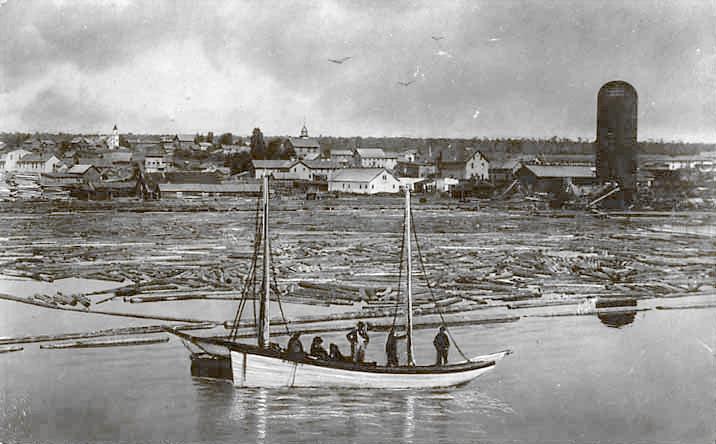
The man was not born in Baraga County, he didn't marry his first wife here, and he died elsewhere so the only legal record was the marriage certificate from when he married again after being widowed. They had hoped to include photographs of the house where their great grandfather lived. The site is now a vacant lot. How about the public school their grandfather attended? Long gone. In fact, even the school that replaced that school is gone -- the current Baraga High School is the third one on the site. Where did he work? The sawmill is gone; the site adjacent to US-41 is now vacant lot and marina. What about the cemetery? Well, there is a grave marker, a simple pillow stone, for the great grandfather, but several other family graves are unmarked.

The man's great grandson stopped by the museum the other day. He was hoping we might have some historical photos on file that included either views of the buildings related to his great grandfather's life or group photos of some sort that included the man. I was able to provide some turn of the century street scenes and a nice view of the Thomas Nester sawmill, but there were no group photos or portraits that were labeled with the person's name. There was one group photo of sawmill employees in which only about half the men were identified; the great grandson said that one of the unnamed men strongly resembled the descriptions of his great grandfather so he asked for a copy of it. Is it a match? Who knows -- his great grandfather was a physically small man with a large mustache; the fellow in the photo was a physically small man with an impressive mustache. But so were three of the other guys in the picture.

The whole experience left me feeling rather melancholy.

Wednesday, October 24, 2012

How common are window displays?

I know there are numerous businesses offering affordable caskets and other funeral goods that most funeral homes would prefer to retain control over, but I do believe this is the first time I've seen a window display of a casket. It's a John Deere model on display in a business (Pearson's Cemetery Services) located next to state highway 87 in Hemphill, Texas. The business also offers cemetery services, e.g., grave maintenance and gravestone leveling, and sells monuments and markers.

Saturday, December 10, 2011

If you thought the gift shops at Disneyland were bad

An elderly relative died this past Monday; the funeral was yesterday. In most ways, it was a pretty typical event. The decedent was quite old, she'd been in declining health for a number of years, and her demise was not unexpected. People were understandably sad, tears were shed, and life goes on. The funeral itself was what one would expect -- the minister talked about the wonderful characteristics of the decedent (a woman he had  met one time, and then only briefly) while those of us in the pews did our own mental editing/reality check. (If the dearly departed were even half as wonderful as eulogies always make the deceased sound, it would be a lot harder to let go.) The only surprising thing was that the church was not as full as I had thought it would be given how active the woman had been in the community in her younger days, but then I realized that the decedent had simply managed to outlive most of her contemporaries.

Visitation at the funeral home the night before held a few surprises, though. I've always been intrigued about customs and practices surrounding death, the various attitudes and rituals and their evolution over time. Americans have always struck me as being a tad squeamish about the subject. After all, the culture has abdicated personal responsibility by allowing professional funeral directors to take over what were once intimate family tasks: preparing the body for burial, for example, and digging the grave. For centuries, too, western culture has isolated the dead from the living: unlike some cultures where the bones of revered ancestors become part of the household (e.g., skulls up on the ceiling beams or bones buried in the floor), western European societies planted the dead in graveyards. That's changed a little with the advent of cremation -- during the 20th century it became acceptable, if not widely common, to have the cremains of a loved one residing in a tasteful urn on the credenza in the living room.

I've got to admire the funeral industry for managing to take that tasteful urn and move it to a whole new level. While sitting around sipping coffee at the funeral home, I realized I'd inadvertently wandered into the world's creepiest gift shop. The built-in bookcases and various other surfaces were full of display models of different items grieving families can purchase. You can now get individual urns:
Instead of the deceased's ashes residing in one large urn for all eternity, you can divide him or her among the family members. Personally, I find this a little creepy, but I know not everyone feels that way -- my older grandson was the recipient of such an urn after his other grandmother died a few years ago, and he seems quite happy to have it.

Individual urns not quite your thing? Or there are so many family members (and the decedent was a frail little thing who's not going to provide much ash to work with) that even the small urns are too large? How about some cremation jewelry? You can have ashes compressed into fake diamonds, or you can go for something a little less intense, like a heart you can wear as a necklace or on a charm bracelet:
What about the men, you ask? After all, guys aren't likely to want to wear a heart-shaped pendant no matter how much they loved their mother. Got them covered. Keychains, with a wide variety of designs to pick from:
I can see it now -- "I'll take the one with the gecko on it. Mom always loved those GEICO ads."

The options for stuff you can do with cremains don't stop with urns and jewelry, of course. You can take those ashes and have them made into stained glass. You can buy various pieces of innocuous looking household items that have compartments for cremains: desk lamps, for example. You can get urns that look like bookends (and can be used the same way) if you want to be subtle, or you can get urns that look like miniature caskets or sarcophagi if you want the urn to be a blatant piece of memento mori.

But what about families who don't opt for cremation? Aren't they kind of S.O.L. when it comes to death memorabilia? Not really. There are now these nifty little pieces of jewelry, which get sold by companies such as Thumbies:
You can have your loved one's fingerprints permanently embedded in a piece of (not cheap) jewelry that you can treasure forever. Holy crap. First they guilt you into the Cadillac casket, and then they swing into full up-sell mode by peddling tchotchkes to help guarantee that whatever estate the decedent had is thoroughly eviscerated. I'd love to hear the sales pitch for this stuff. What can they possibly say? Your mother's last wish was to be fingerprinted? She never had a chance to do one of those plaster-of-paris wall plaques in kindergarten; here's your opportunity to make it up to her?

Bottom line: prearrangements are looking better and better. Signing up with a burial society, making damn sure everyone knows the one and only thing I want is the absolute cheapest cremation done as quickly as possible, ashes in a milk carton or coffee can because they're going to get scattered, and no money whatsoever being spent in the world's creepiest gift shop.

[cross posted at All the Good Names Were Taken]

Saturday, April 9, 2011

So tempting

Would the ghostwriter question the client's veracity? Or simply go along with some individual revisionist history? It might kind of nice to have the grandkids thinking I won a Pulitzer or climbed Everest. . . Considering the service costs $100 an hour, with a typical fee of $250 to $500, you'd hope a little creative license would be fine.

Sunday, January 23, 2011

Barnes Hecker

I came across this photo of the rather odd Ely Township Centennial/Barnes Hecker mine disaster memorial while scanning my dad's slide collection.  He took the photo shortly after the marker was erected. The marker has since been moved to the grounds of the Michigan Mining Industry Museum in Negaunee Township -- I'm not sure why. The marker was not at the actual mine site to begin with, so it wouldn't seem to make much sense to move it from one township to another.  The marker used to be next to US-41 a few miles west of Ishpeming.

It always struck me as an odd memorial -- the combination of commemorating the township centennial with remembering what is still considered one of the worst mining disasters in US history is a bit strange.

Monday, January 3, 2011

Four Sabine County, Texas, cemeteries

The Mt. Sinai Cemetery is a relatively old cemetery, with its first interment dating back to 1894, and is located in the community of Fairmount close to the Beechwood subdivision on the Toledo Bend reservoir.  The cemetery does include graves with older markers; these are reinterments necessitated when three local cemeteries located closer to the Sabine River were inundated following construction of the Toledo Bend dam in the mid-1960s.   The cemetery includes a number of interesting markers, as well as this poignant tableau:  

The swing faces this marker:
One can only assume that Gerald's parents spent quite a few hours in the swing while visiting with their deceased son. 

Mt. Sinai also includes this amazing stainless steel marker:

The photos don't do it justice.
 The Fairmount Cemetery is located on Texas Highway 87.

Like the Mt. Sinai Cemetery, it is relatively old and has a Texas Historical Commission book on a stick providing a brief history:

I was actually more intrigued by the sign instructing people not to bury pets in the cemetery (enlarge the first photo to see; it's the smaller sign on the fence) -- is that a common problem?  Most markers in the cemetery were standard, 20th century commercial stones, although there were a few graves marked only with fieldstones:
There was also one vernacular marker that was a little unusual in having a replacement gravestone placed adjacent to it.  Usually the vernacular stones are discarded when a commercial stone replaces them.
 The Ener Cemetery near Yellowpine is a traditional pioneer family cemetery. 

A few of the older stones have weathered to the point of being difficult to read, but most are still quite legible, and are standard commercial markers.
The Yellowpine Cemetery is a relatively new community cemetery.  Like the other three, it is well maintained.
I'm always intrigued when cemeteries located close to each other geographically exhibit different customs or practices, and Yellowpine does have a few characteristics not seen at Mt. Sinai or Fairmount.  Putting an edging around the family plot and keeping it neat with sand or crushed white rock is a popular practice:
This plot with its carefully raked sand is reminiscent of a Zen garden:
I was also quite frankly stunned by this:
I'm hoping this has some meaning for the family that isn't obvious to an outsider, because "Ho! Ho! Ho!" feels like a rather odd sentiment to place on a grave.

Thursday, July 22, 2010

Warren G. Harding Tomb, Marion, Ohio

Two photos taken in August 1988.  The Harding tomb was designed to have one column for every state in the Union, but by the time construction began the Teapot Dome scandal and others had hit the newspapers and donations dried up, resulting in it falling two short, 46 instead of 48.  Given Warren G. Harding's current reputation historically, it can be a little hard to believe the country was devastated when he died in office.   
Some historians believe that Harding, who was personally honest (his weakness was women, not lining his pockets) was beginning to realize just how corrupt some of his friends and cronies were and that the stress of worrying about impending scandal contributed to his untimely death.  There's also been speculation that his jealous wife had him poisoned, but it's most likely he died from complications of a food-borne infection.  No one knows for sure because the doctors who had been treating him just prior to his death all gave different descriptions of his illness, and his wife had him embalmed in record time. 

Monday, June 7, 2010

Words fail me

Located in Galloway, Wisconsin, at the intersection of County Highway C and Wisconsin state Highway 49.  It's more colorful in person, if such a thing is possible.

It does pay to get off the Interstate occasionally.

Photo taken May 26, 2010, enroute to Antigo from Stevens Point.

Sunday, May 2, 2010

Paint Rock, Alabama

The northwest corner of the intersection of state highway 65 and US highway 72. No identifying information and, given the weeds starting to block them, no recent maintenance.

Friday, February 12, 2010

Emmet Cemetery, Dodge County, Wisconsin

I found this nifty example of a modern personalized vault while on vacation last summer.  I was taking Wisconsin highway 26 north from Janesville to Oshkosh and was feeling the need for a break from driving when I spotted the Emmet Cemetery.  I decided to stop, stretch my legs, and see if there were any markers of note, e.g., zinc or vernacular concrete.  
It's a typical rural community cemetery, and at first didn't appear to contain anything out of the ordinary.  The markers were a mix of popular styles dating back to the late 19th century, the usual tablets and obelisks with the exception of one tree marker. 
The tree was meant to designate a family plot.  There is one individual grave marker close to it, a small stump.  I'm always a little intrigued when I see that, a family plot that someone obviously intended to be the final resting place of multiple family members but only one or two persons end up interred there.  What happened to the rest of them?  Moved away?  Decided the idea of spending eternity next to one's parents or siblings had no appeal?  
The Sterwald vault shown is at the extreme rear of the cemetery, more or less at the center of the back row.  It is undoubtedly one of the niftiest modern personalized markers I've seen recently.  The use of color, the aerial view of the farm, the inclusion of the family pets (2 dogs, 2 cats) and the tractors . . . it's amazing. 

Photos were taken in late June 2009. Apologies for the mediocre quality; I was using a new camera and still figuring out how it worked.

Thursday, December 3, 2009

National Foxhound Hall of Fame Cemetery


I'd heard about the "dog cemetery" on the Sabine National Forest in east Texas, so was really curious to see it last week.  It definitely was not what I expected. 


Most markers are simple pillow stones engraved with the name of the dog, his or her regisration number, date whelped and date died, and the owners.  Most also include the dog's home state; one marker even includes a metal photocopy of the dog's registration papers (complete with photo).  Still, most are simple pillow stones.  The marker below is an exception. 


One thing that surprised me was the geographic range of the dogs -- everywhere from Arkansas to Florida.  I knew there were fox hunting enthusiasts in Texas; I didn't realize this particular dog cemetery was a national one.


Another thing that surprised me was the location.  When someone says a cemetery is in a national forest, I immediately picture a site similar to the Clark-Dickey-Smith cemeteries described in a previous post:  a cemetery located basically in the middle of nowhere, tucked away in the woods at the end of a rather rough dirt road, and looking rather neglected and forlorn.  Not this dog cemetery.  It's on the northern end of the Sabine National Forest not far from the town of Shelbyville and is extremely easy to find:  it's at Boles Field, a popular campground.  The cemetery, in fact, sits between a line of camp sites that are set up for RVs (the sites have electrical hookups) and a paved two-lane road.

It is also obviously still an open cemetery -- only half the area enclosed by the posts is occupied; there's plenty of room for future champions to rest beneath the Texas pines. 

Above photo is the back of the tablet marker at the top of this post.  Below is a stock photo lifted from the internet of an American foxhound, just in case someone reads this who has no idea what the breed looks like.  With the exception of the foxhound, photos were all taken November 27, 2009.


Tuesday, December 1, 2009

Clark-Dickey-Smith cemeteries, Sabine County, Texas


This is an odd site in Sabine County, Texas:  two cemeteries located literally spitting distance from each other.  In urban terms, they're less than half a standard city block apart.  No other traces of a community remain so it's difficult to say how they were located historically, e.g., were they once separated by a road?  As the book-on-a-stick notes, at one time a settlement existed that included several families.  I'm told there was also a cane mill, but no evidence of that settlement other than the cemeteries exists today. 

The Clark-Dickey cemetery is larger and, at a guess, appears to have been used for a longer time.  There are a number of fieldstone markers in addition to the commercial stones.  The cast concrete markers with hand lettering appear to be fairly recent, and may have been added at about the same time the historical marker was planted.

The Clark-Dickey cemetery includes half a dozen or so of the vernacular cast concrete tablet style markers like the one shown below; none were made using lettering kits.


Both cemeteries are surrounded by chain-link fence that's fairly new and in generally good condition, although a tree had fallen recently (within the past year) on the fencing for the Smith cemetery. 


The photo above is from the Smith Cemetery; it's the most noticeable grave there.  No inscription was visible on the tablet. 

The book-on-a-stick erected by the Texas Historical Commission suggests that both cemeteries began as family cemeteries, but notes a connection between the two, making it even odder that they're physically separate.  Local sources suggested that the fencing is wrong, the two cemeteries were connected, and more graves exist than are currently known or marked.  Whether or not that's true would require a thorough archeological survey, including the use of ground penetrating radar, a highly unlikely scenario given that both cemeteries appear to fall within the Sandy Creek riparian zone and are thus unlikely to be impacted by any future logging operations on that portion of the Forest. 

Both cemeteries are located on the Sabine National Forest.